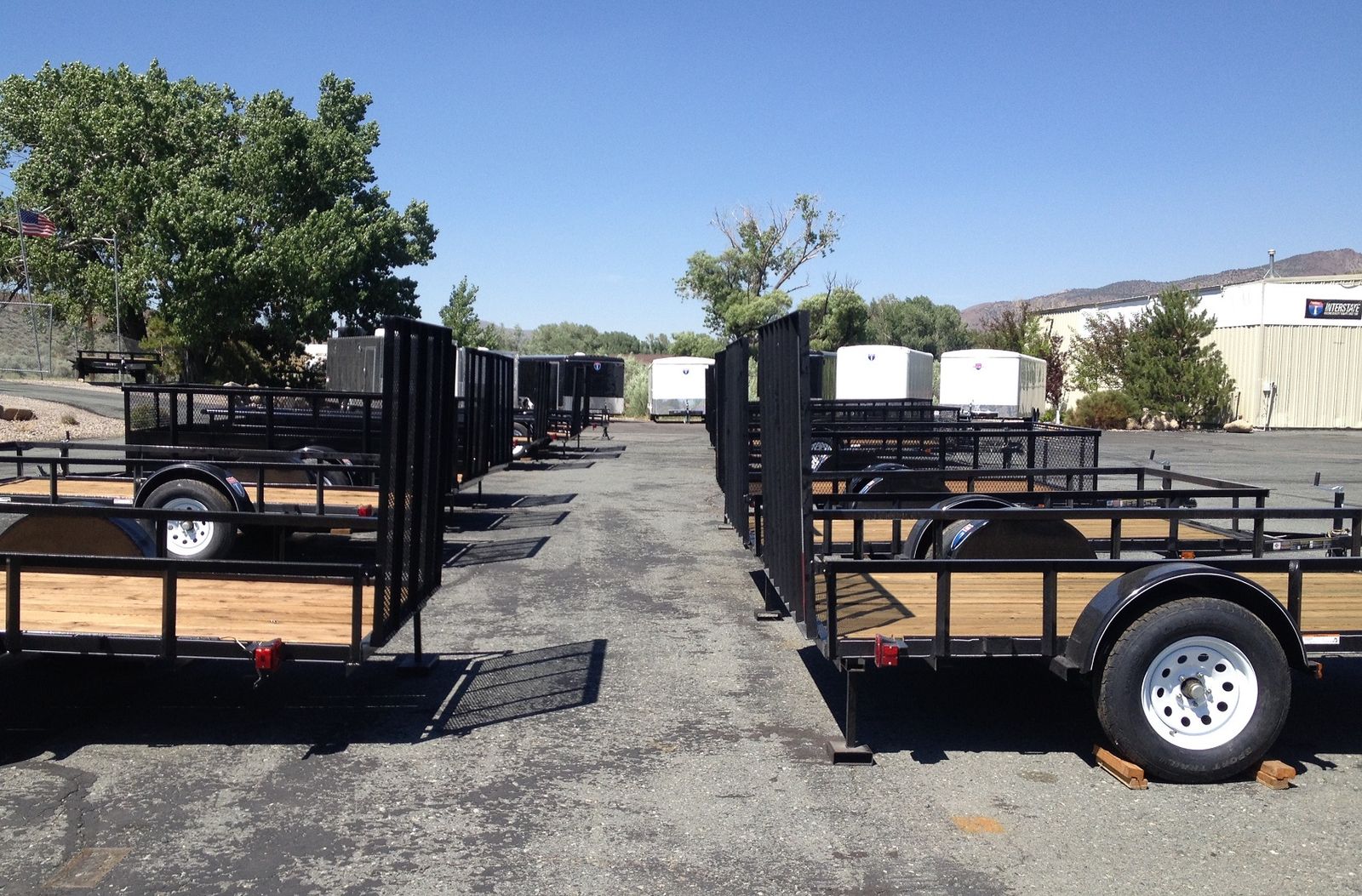
- Utility Trailers
- Trailer Knowledge
Key Takeaways: Quick Decision Guide
- Shop payload, not deck size. The smallest open utility trailer often carries more weight than the largest one in the same rating class.
- Carry-On is the line to look at first. It covers the widest range of open decks, sizes and rail packages on the lot.
- Single axle covers most homeowners. Yard waste, a mower, a dump run and the occasional furniture move all sit inside its range.
- Tandem axle is about behavior as much as capacity. It rides flatter under an uneven load and holds its line better on gravel.
- Tilt decks remove the ramp problem for anything with low ground clearance or a long wheelbase.
- Deckover equipment trailers are a different category, built for machinery rather than bulk.
If you are buying your first open trailer and you are not sure which type you need, start with a single-axle utility trailer in the approximately 2,990 lb class. It covers the widest range of homeowner and light trade work, parks in a normal driveway and tows behind most vehicles that can tow at all. You move up from there only when a specific job forces it, and this guide is about recognizing which job that is.
Carry-On is the primary open utility line here and covers the widest span of sizes, rail heights and axle configurations. Interstate also builds open utility and tilt decks, and the two overlap at the smaller end. The wider open utility trailers range splits into four practical types, and the differences between them are less about size than about how the load gets on and off.
Start With Payload, Because the Numbers Are Not Intuitive
Most people assume a bigger trailer carries more. Within a single rating class the opposite is true, because the trailer's own weight comes out of the same budget. Every trailer has a gross rating, and payload is what is left once the empty trailer is subtracted. A longer deck means more steel, and more steel means less payload.
Across the Carry-On single-axle range, all rated at approximately 2,990 lbs, payload moves in the opposite direction to size:
- 5x8: deck of roughly 8 feet by about 5 feet, payload of approximately 2,215 lbs.
- 5x10: deck of roughly 10 feet by about 5 feet, payload of around 2,190 lbs.
- 6x10: deck of roughly 10 feet by approximately 6 feet 4 inches, payload close to 2,140 lbs.
- 6x12: deck of roughly 12 feet by approximately 6 feet 4 inches, payload in the range of 2,115 lbs.
- 6x14: deck of roughly 14 feet by approximately 6 feet 4 inches, payload around 2,090 lbs.
Please note: Listed dimensions and specifications are approximate and subject to change. Please verify exact dimensions with your local store before purchase.
The Interstate utility decks behave the same way across a slightly wider spread, running from roughly 2,440 lbs on a 5x8 down to approximately 2,010 lbs on a 6x12.
Please note: Listed dimensions and specifications are approximate and subject to change. Please verify exact dimensions with your local store before purchase.
The gap between the smallest and largest is roughly 125 lbs on the Carry-On decks and closer to 430 lbs on the Interstate ones, which is a real difference if you haul anything dense. Gravel, sand, pavers, wet soil and roofing tear-off hit the weight limit long before they fill the deck. Mulch, brush, furniture and yard waste fill the deck long before they hit the weight limit. Which of those describes your work should decide whether you optimize for payload or for deck space.
Single-Axle Open Utility: The Default Answer
A single-axle open utility trailer is a flat deck with low rails, a ramp or tailgate at the rear, and one axle under the middle. It is the cheapest trailer that does real work, the easiest to store, and light enough that one person can move it by hand on level ground.
It suits homeowners, weekend projects, light landscaping and anyone whose hauling is occasional rather than daily. The limits show up in two places. Loads that need to ride flat and level, like a piece of furniture on a long haul, move more on a single axle. And a blown tire on a single-axle trailer puts the load on the ground, where a tandem gives you a second wheel on that side.
Rail Height: The Option Most Buyers Overlook
Carry-On decks come in more than one rail package, and the difference decides how much you can actually stack. The standard gated wood deck runs rails of roughly 14 inches. A mid-height package sits near 21 inches, and the high-side package runs approximately 24 inches.
Taller rails cost payload, because the extra steel comes out of the same budget. A 6x12 with standard rails offers payload around 2,115 lbs; the same deck in the high-side package drops to roughly 1,991 lbs. That is a trade of about 125 lbs of capacity for roughly 10 inches of height, and which side of it you want depends entirely on whether your loads are dense or bulky.
Please note: Listed dimensions and specifications are approximate and subject to change. Please verify exact dimensions with your local store before purchase.
Tandem Axle: Stability First, Capacity Second
Adding a second axle changes the rating substantially, and it is where the open utility range stops being a light-duty category. A braked tandem 6x12 Carry-On deck is rated near 7,000 lbs with payload around 5,650 lbs, against roughly 2,115 lbs for the single-axle version of the same deck. Stretch to a 7x16 tandem and payload sits near 5,350 lbs, with a heavy-duty version rated closer to 9,990 lbs carrying approximately 7,790 lbs.
Please note: Listed dimensions and specifications are approximate and subject to change. Please verify exact dimensions with your local store before purchase.
Capacity is not usually why people buy one, though. Tandem trailers track straighter, ride flatter under a load that is not centered, and recover from a sway input in a way single-axle trailers do not. Anyone towing at highway speed for more than an hour at a time tends to notice.
The cost is real. Two axles means four tires, four bearings and typically brakes, all of which need service. For a trailer that gets used a handful of times a year that is money spent on capability you are not using. For a trailer that works most weeks it is money well spent.
Tilt Decks: When Ramps Are the Problem
A tilt trailer's deck pivots so the rear end reaches the ground, which turns the whole deck into the ramp. There is nothing to unfold, nothing to stow and no gap between ramp and deck for a low wheel to catch on.
This matters for anything with low ground clearance, a long wheelbase or small wheels: zero-turn mowers, side-by-sides, compact tractors, scissor lifts. A 6x12 tilt gives you a deck of roughly 11 feet 10 inches by about 6 feet 4 inches and is rated near 5,200 lbs with payload around 3,590 lbs, which is a substantial step up from the single-axle open utility trailers at a similar deck size.
Please note: Listed dimensions and specifications are approximate and subject to change. Please verify exact dimensions with your local store before purchase.
Deckover and Equipment Trailers: A Different Category
Once the load is machinery rather than material, you are looking at deckover equipment trailers instead. A deckover puts the deck above the wheels rather than between them, which gives you full width across the whole platform with no wheel wells to work around.
An 8.5x20 equipment trailer runs a deck of roughly 20 feet by about 8 feet 6 inches. Rated at approximately 9,990 lbs it offers payload close to 6,760 lbs, and the heavier version rated near 14,000 lbs pushes payload into the range of 10,160 lbs. Those numbers put it in a different conversation from anything in the utility range.
Please note: Listed dimensions and specifications are approximate and subject to change. Please verify exact dimensions with your local store before purchase.
If what you move is loose rather than solid, the answer is neither. Gravel, soil, compost and demolition debris all want to be tipped out rather than shoveled off, which is what the dump trailer configurations are built for.
Matching the Type to the Work
Homeowners with a normal lot and a garage to store it in are almost always right with a single-axle open utility trailer. The deck size question comes down to whether your typical load is heavy or bulky.
Landscapers and property owners moving material weekly usually want a tandem, both for the capacity and because the trailer spends its life loaded unevenly. Anyone whose main load is a machine should be looking at a tilt deck before anything else, because loading is the part of the job that goes wrong.
Trades moving equipment between sites belong in the equipment category, not the utility one, and the deck rating is the figure to check rather than the deck length.
Compare the Types in Person
Deck dimensions and payload figures are useful for narrowing the field and unreliable for making the final call, because configurations vary and a few inches of deck width decides more than a spec sheet suggests.
TrailersPlus is the nation's largest independent trailer dealer, with over 90 locations nationwide. It is the only retail seller of Interstate, America's number one brand in cargo trailers, and carries Carry-On across the open utility range. Roughly 95 percent of trailer weight is sourced in the USA, and customers rate the company 4.8/5 across more than 10,000 reviews. Stop into a local TrailersPlus store to stand next to the types side by side. If budget is driving the decision, the marked-down trailer inventory is worth checking before you shop new.
Frequently Asked Questions
What is the difference between a utility trailer and an equipment trailer?
A utility trailer is built for bulk: yard waste, materials, furniture, general hauling. An equipment trailer is built for machinery, with a heavier frame, a higher rating and ramps designed for driving something on. The practical test is whether your load rolls or drives onto the deck under its own power.
Why does a smaller utility trailer sometimes carry more weight?
Because payload is the gross rating minus the trailer's own empty weight. Within one rating class a longer trailer weighs more, so it has less payload left over. A 5x8 and a 6x12 can share the same rating of approximately 2,990 lbs while the 5x8 carries roughly 430 lbs more.
Do I need a tandem-axle trailer for home use?
In most cases no. Single-axle trailers cover typical homeowner hauling and cost less to buy and maintain. Tandems make sense if you tow at highway speed regularly, if your loads are usually near the rating, or if you want the stability a second axle provides.
What is a tilt trailer used for?
Anything that is awkward to drive up a ramp. The deck pivots to the ground so there is no ramp angle and no gap to catch a low wheel. Mowers, side-by-sides and compact tractors are the common loads.
Can I haul a car on a utility trailer?
Generally not, and it is worth checking the rating carefully before trying. Most utility trailers are rated well below the weight of a typical car, and the deck length is usually short of what a car needs. A car hauler or an equipment trailer is the right category.