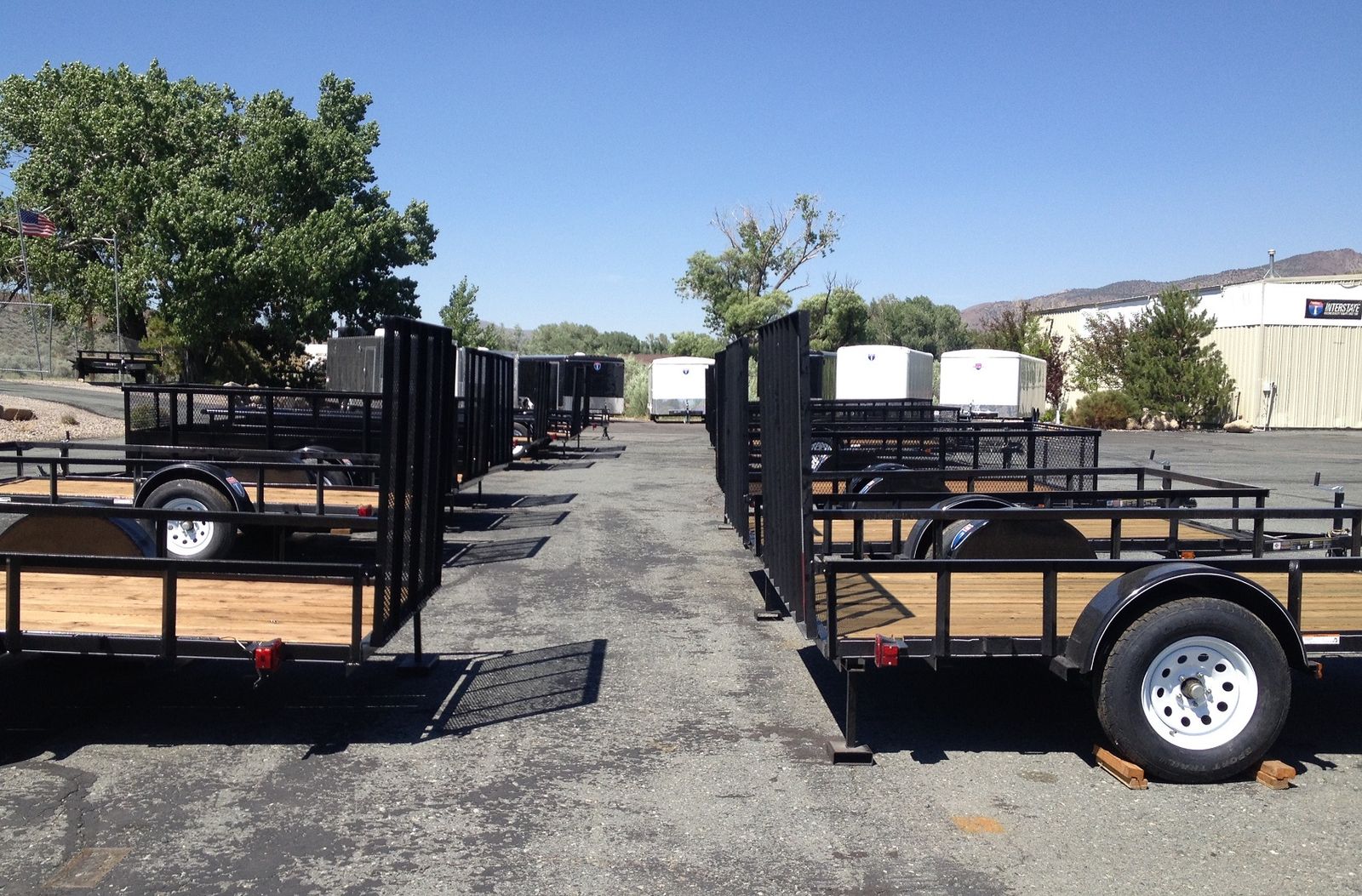
- Utility Trailers
- Trailer Knowledge
Key Takeaways: Quick Decision Guide
- Most small utility trailers are rated around 2,990 lbs gross: That figure is the trailer plus everything on it, not the load by itself.
- Usable payload typically lands between 2,000 and 2,450 lbs: Subtract the trailer's empty weight from its gross rating and what remains is yours.
- Smaller trailers carry more, not less: A 5x8 weighs less empty than a 6x12 at the same gross rating, so it leaves you a few hundred extra pounds of capacity.
- Volume fills before weight does with light material: Brush and furniture run out of space first. Soil, gravel and pavers run out of weight first, often before the deck looks full.
- Tilt models jump to a different class: A 6x12 tilt trailer is commonly rated near 5,200 lbs, leaving roughly 3,600 lbs of payload.
A small utility trailer typically handles somewhere between 2,000 and 2,450 lbs of payload. Most single-axle models in the 5x8 to 6x12 range carry a gross weight rating of approximately 2,990 lbs, and the trailer's own weight of roughly 550 to 1,000 lbs comes out of that figure before you load anything.
The rest of this guide shows you how to find your own number, why the smallest trailer often carries the most, and how common materials measure against those limits. Figures are drawn from our current open utility trailers.
The Two Numbers That Matter
Trailer capacity gets described loosely, which causes most of the confusion. There are really only two figures to understand.
- Gross vehicle weight rating: The maximum the trailer is rated to weigh in total, including its own structure. This is stamped on the certification label and it is a limit, not a target.
- Empty weight: What the trailer weighs before you put anything on it. Also called unloaded or dry weight.
Payload is the difference between the two, and it is the only figure that describes what you can actually carry. A trailer advertised as a 2,990 lb model is not a trailer that carries 2,990 lbs of cargo. Reading the rating as a cargo capacity is the most common mistake buyers make, and it typically overstates the real figure by a third or more.
Real Capacity by Size
These are current figures across common single-axle utility sizes. Note that capacity moves in the opposite direction to size, because the gross rating stays the same while the trailer gets heavier.
5x8 Single Axle
- Gross rating approximately 2,990 lbs, empty weight around 550 lbs.
- Usable payload roughly 2,440 lbs, the highest in the small utility range.
- Deck approximately 8 feet by 5 feet, with a deck height around 19 inches.
Please note: Listed dimensions and specifications are approximate and subject to change. Please verify exact dimensions with your local store before purchase.
5x10 and 6x10 Single Axle
- Gross rating approximately 2,990 lbs, empty weight roughly 745 to 935 lbs depending on width.
- Usable payload roughly 2,050 to 2,250 lbs.
- Deck length about 9 feet 10 inches, with width around 5 feet or 6 feet 2 inches.
Please note: Listed dimensions and specifications are approximate and subject to change. Please verify exact dimensions with your local store before purchase.
6x12 Single Axle
- Gross rating approximately 2,990 lbs, empty weight around 985 lbs.
- Usable payload roughly 2,000 lbs, the lowest of the group despite the largest deck.
- Deck approximately 11 feet 10 inches by 6 feet 2 inches.
Please note: Listed dimensions and specifications are approximate and subject to change. Please verify exact dimensions with your local store before purchase.
The pattern is worth internalizing before you shop. Moving from a 5x8 to a 6x12 gains you about four feet of deck length and costs you roughly 440 lbs of carrying capacity. Buyers hauling dense material are often better served by the smaller trailer, while those hauling bulky light loads want the longer deck.
What That Capacity Means in Practice
Abstract weight figures are hard to judge, so it helps to translate them into loads people actually haul.
- Topsoil: A cubic yard commonly weighs somewhere around 2,000 to 2,400 lbs damp. A small utility trailer is generally at its limit with a single yard.
- Gravel: A cubic yard often runs past 2,600 lbs. Half a yard is usually a sensible load, and the deck will look barely covered.
- Riding mower: Commonly 400 to 800 lbs, well within range with room for tools and a trimmer.
- ATV: Typically 500 to 900 lbs, comfortably handled with gear alongside.
- Household junk run: Furniture and general clutter usually fill the deck long before the weight limit arrives.
- Firewood: A cord of seasoned hardwood can approach or exceed 3,000 lbs, which generally puts a full cord beyond a small utility trailer.
The general rule is that anything you shovel is a weight problem and anything you carry is a volume problem. Loads that look modest are frequently the ones that overload a trailer.
When You Need More Than a Small Utility Trailer
Two upgrade paths exist, and they suit different problems.
A tilt model is the middle step. A 6x12 tilt trailer is commonly rated near 5,200 lbs with an empty weight around 1,610 lbs, leaving roughly 3,590 lbs of payload, and the tilting deck removes the need for separate ramps. Anyone regularly loading wheeled equipment finds that convenience worth more than the numbers suggest. Those hauling loose material in quantity should look instead at commercial dump trailers, where a 6x12 commonly carries 6,600 lbs or more and unloads itself.
Anyone whose loads need protection from weather or theft is generally better served by an enclosed format. Our comparison of 6x12 and 7x14 cargo trailers covers where those sizes land.
Loading Safely Within the Limit
- Find your certification label: It carries the gross rating and is usually on the tongue or the frame near the front left. That figure governs, whatever a brochure says.
- Weigh the trailer if the empty figure is unclear: Public scales at landscape suppliers and recycling centers make this straightforward.
- Load about 60 percent forward of the axle: Too much weight behind the axle reduces tongue weight and invites sway at speed.
- Check tire pressure cold before loading: Underinflated tires are a common failure point on trailers that sit unused between jobs.
- Remember your tow vehicle has limits too: Tongue weight counts against your vehicle's payload alongside passengers and cargo.
Anyone unsure how their trailer's rating interacts with their vehicle should read our explanation of trailer GVWR and responsible towing, and confirm the ball mount and hitch rating separately, since the lowest-rated component sets the real ceiling.
Find the Right Utility Trailer at TrailersPlus
TrailersPlus is the nation's largest independent trailer dealer, carrying Interstate trailers across over 90 locations nationwide. Store staff can read the certification label on the exact unit you are considering and confirm the empty weight, which is the figure that decides your real capacity. Browse the current trailer inventory to compare ratings across sizes, or find a trailer dealership near you to talk through the loads you plan to haul.
Frequently Asked Questions
How much weight can a 5x8 utility trailer hold?
A 5x8 single-axle utility trailer is commonly rated around 2,990 lbs gross with an empty weight near 550 lbs, leaving roughly 2,440 lbs of payload. That is typically the highest usable capacity in the small utility range, since the trailer itself weighs the least.
Can a small utility trailer carry a cubic yard of dirt?
Usually yes, but it is close to the limit. A cubic yard of damp topsoil commonly weighs around 2,000 to 2,400 lbs, which uses most or all of the payload on a typical small utility trailer. Gravel and wet material are heavier still, so half loads are generally the safer approach.
What happens if you overload a utility trailer?
Exceeding the rating puts stress on axles, bearings, tires and the frame, and it lengthens stopping distances considerably. Beyond the mechanical risk, operating over the rated weight can affect insurance positions and may attract enforcement, so staying within the label figure is worth the discipline.
Is the GVWR the same as how much I can carry?
No, and this is the most common misunderstanding. Gross rating includes the trailer's own weight, so your carrying capacity is the rating minus the empty weight. On a small utility trailer that difference is commonly 550 to 1,000 lbs.
Do I need trailer brakes on a small utility trailer?
Brake requirements are generally tied to gross weight and vary from state to state, and many small single-axle utility trailers fall below the common thresholds. Because the rules differ by jurisdiction, confirming what applies where you tow is the reliable approach.