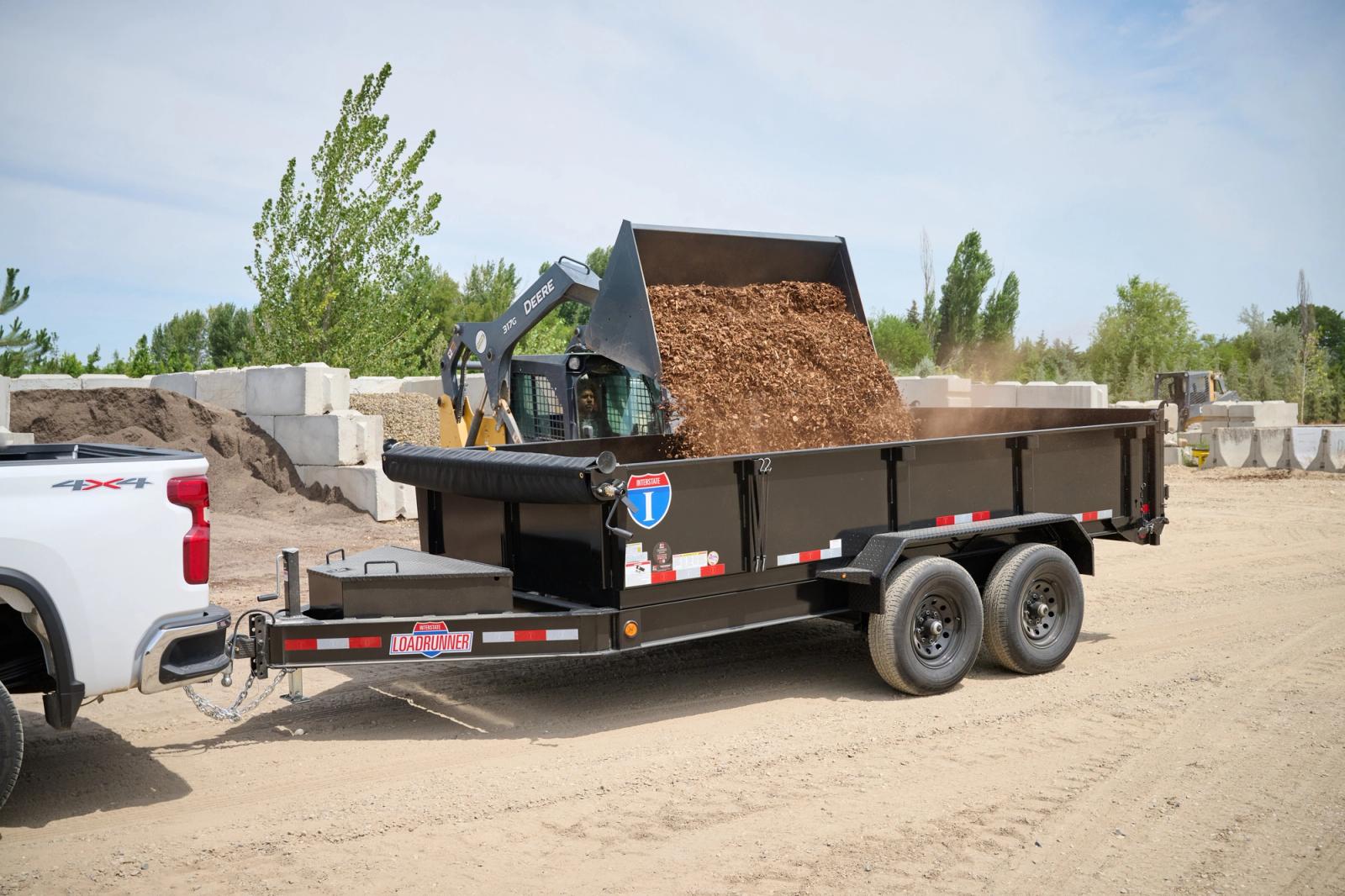
- Dump Trailers
- Utility Trailers
- Trailer Knowledge
Key Takeaways: Quick Decision Guide
- The real difference is payload, not tipping: A 6x12 dump trailer typically carries somewhere between 6,500 and 8,000 lbs, while a 6x12 utility trailer lands nearer 2,000 lbs. That is roughly a three to four times jump.
- Choose a dump trailer for loose material: Gravel, soil, mulch, demolition debris and anything you would otherwise shovel off by hand.
- Choose a utility trailer for wheeled and bulky items: Mowers, ATVs, appliances, lumber and furniture do not need a hoist and do not need the extra weight rating.
- Dump trailers need a heavier tow vehicle: Loaded ratings commonly run from around 7,000 lbs up to 14,000 lbs, which generally puts them beyond what a half-ton truck should be pulling at the upper end.
- Hoist style affects how it dumps: Scissor hoists lift heavier loads more evenly, while single and dual ram setups suit lighter, faster cycles.
If you are hauling loose material that has to come off the trailer without a shovel, buy a dump trailer. If you are hauling wheeled equipment, appliances or building materials that you will unload by hand or with a ramp, buy a utility trailer. The tipping bed is the visible difference, but the payload gap underneath it is the one that should actually drive your decision.
The two formats sit in different weight classes rather than being variations on a theme. Figures below are drawn from our commercial dump trailers and open utility trailers.
The Payload Gap Is Larger Than Most Buyers Expect
Two trailers with the same footprint can be built to entirely different weight ratings. This is the single most useful thing to understand before you shop.
6x12 Utility Trailer
- Gross weight rating typically around 2,990 lbs.
- Empty weight roughly 980 lbs, leaving approximately 2,000 lbs of payload.
- Single axle, with a deck height around 19 inches.
- Deck width roughly 6 feet 2 inches, length about 11 feet 10 inches.
Please note: Listed dimensions and specifications are approximate and subject to change. Please verify exact dimensions with your local store before purchase.
6x12 Dump Trailer
- Gross weight ratings commonly run about 9,990 lbs, with heavier configurations reaching roughly 12,000 lbs.
- Empty weight in the range of 2,400 to 3,900 lbs depending on configuration, leaving approximately 6,600 to 8,200 lbs of payload.
- Tandem axle as standard, with a bed height around 21 inches.
- Bed width roughly 6 feet, length about 11 feet 10 inches.
Please note: Listed dimensions and specifications are approximate and subject to change. Please verify exact dimensions with your local store before purchase.
A cubic yard of damp topsoil weighs somewhere around 2,200 lbs and a cubic yard of gravel can run past 2,800 lbs. On those numbers a utility trailer is at its limit before the bed looks anywhere near full, while a dump trailer of identical footprint takes three yards without difficulty. Buyers who load by volume rather than by weight are the ones who get caught out.
Unloading Is Where the Time Goes
The purchase decision often comes down to how many minutes you spend at the end of each haul, multiplied by how often you haul.
- Dump trailer: Raise the bed, the load slides out, lower the bed. A cycle takes a couple of minutes and costs you no physical effort.
- Utility trailer: Loose material comes off with a shovel and a wheelbarrow. For a single yard of mulch that is manageable. For three loads a day it is the whole job.
- Wheeled equipment: A utility trailer with a ramp gate is generally faster and safer than a dump bed, because you roll the machine down a fixed gradient rather than working around a hinged bed.
If you are moving loose material more than a handful of times a year, the labor saving usually justifies the price difference on its own. Our breakdown of dump trailer sizes for gravel, dirt and debris works through the volume side of that calculation.
Hoist Types and What They Suit
Not all dump beds lift the same way, and the mechanism affects both what you can carry and how the trailer behaves when the bed is up.
- Scissor hoist: Lifts from the center of the bed through a scissor linkage. It generally handles heavier and denser loads more evenly and holds the bed more stable at full extension, which suits aggregate and demolition work.
- Single and dual ram: Pushes from the front of the bed. The mechanism is simpler and cycles quickly, which suits lighter, higher-frequency loads like mulch and yard waste.
Whichever mechanism you choose, the hydraulics need occasional attention that a utility trailer does not require. Fluid levels, ram seals and battery charge all become part of routine maintenance. That is a fair trade for the labor saved, but it is worth factoring in.
Matching the Trailer to Your Tow Vehicle
This is where the two formats separate most sharply, and it catches people who assume that same size means same towing demand.
A loaded 6x12 utility trailer stays under roughly 3,000 lbs, which most half-ton trucks and many midsize SUVs handle comfortably. A 6x12 dump trailer rated near 12,000 lbs is a different proposition, and the larger 7x14 and 7x16 dump configurations commonly rate around 14,000 lbs. At those weights you are generally looking at a three-quarter-ton truck or heavier, along with an appropriately rated hitch. Our explanation of trailer GVWR and responsible towing covers how to check your own vehicle's limits, and it is worth confirming your ball mount and hitch rating separately, since the weakest component sets the ceiling.
Anyone whose tow vehicle is a half-ton truck and whose work involves regular aggregate hauling should generally size the trailer to the truck rather than the other way round. A 6x10 dump at a lower gross rating is often the practical answer.
Cost, Storage and Resale
Dump trailers cost more up front because they carry a heavier frame, a second axle, brakes and a hydraulic system. They also take up more room and want a charged battery through winter.
Against that, they hold value well and they turn a two-person job into a one-person job. For a landscaping or demolition business the payback is usually measured in labor hours rather than resale. For a homeowner making a few dump runs a year, a utility trailer is almost always the sensible purchase. If the larger machine is the right tool but the timing is awkward, trailer financing options are worth a look.
Find the Right Trailer at TrailersPlus
TrailersPlus is the nation's largest independent trailer dealer, carrying Interstate trailers across over 90 locations nationwide. Standing next to a loaded-rated dump trailer and a utility trailer of the same footprint makes the weight-class difference obvious in a way that specifications on a page do not. Browse the current trailer inventory to compare hoist configurations and ratings, or find a trailer dealership near you to talk through what your tow vehicle can safely handle.
Frequently Asked Questions
Can a dump trailer be used as a regular utility trailer?
In most cases yes. A dump bed with the sides in place carries wheeled equipment and general cargo perfectly well, and many models accept ramps for loading. You are paying for hoist capability you may rarely use, and the extra empty weight reduces how much payload you have left, but the flexibility is genuine.
What size dump trailer do I need for a cubic yard of gravel?
A cubic yard of gravel commonly weighs somewhere between 2,400 and 2,900 lbs depending on material and moisture. A 6x10 or 6x12 dump trailer typically handles two to three yards within its rating. Calculating by weight rather than by visual capacity is generally the safer approach.
Do dump trailers need brakes?
Braking axles are commonly standard on tandem-axle dump trailers given the weight ratings involved, and most state rules tie brake requirements to gross weight. Because thresholds vary by state, confirming the rules where you tow is worth doing before your first load.
Is a utility trailer enough for landscaping work?
For crews mainly transporting mowers, trimmers and hand tools, a utility trailer is often sufficient and easier to tow. Once the work regularly involves hauling soil, mulch or removing debris, the shovel time usually pushes the decision toward a dump trailer.
How long does a dump trailer take to unload?
A typical dump cycle takes a couple of minutes from raising the bed to lowering it, though sticky or wet material can need a second lift. The meaningful comparison is against shoveling the same load off an open deck, which can take the better part of an hour.