- Cargo Trailers
- Utility Trailers
- Trailer Knowledge
Key Takeaways: Quick Decision Guide
- Choose enclosed if security or weather matters. Anything that cannot get wet, or is worth stealing, belongs behind locked doors.
- Choose open if you load from the side or from above. Mowers, mulch, brush and appliances go in faster with no roof in the way.
- An open deck carries more at the same size, because the box itself weighs several hundred pounds.
- Enclosed costs more to buy and more to tow, since walls and roof add both weight and wind resistance.
- Size is rarely the tiebreaker, because both formats are stocked in the same common footprints.
If your load needs to stay dry and locked, buy enclosed cargo. If you load bulky or dirty items and want the lightest, cheapest trailer that does the job, buy open utility. That is the decision in one line, and almost everything else follows from how the trailer is loaded rather than from how much it carries.
Both formats are built on the same steel frame principles and both are stocked in the same common footprints, so this is a use-case decision rather than a quality one. Comparisons here draw on the enclosed cargo trailer sizes and the open utility range.
The Core Difference Is Access, Not Capacity
An enclosed cargo trailer is a locking box on wheels. You load through a rear ramp or barn doors, sometimes with a side door as well. An open utility trailer is a deck with low rails, loaded from the back, either side, or straight down from above.
That access difference drives nearly everything else. Sliding a washing machine over a low side rail takes seconds. Getting the same appliance through a rear door and down a narrow enclosed aisle takes considerably longer. The reverse is equally true: a tool bag left in an open trailer is a tool bag you may not see again.
Payload: The Result That Surprises People
Buyers often assume the enclosed trailer is the heavy-duty option. At the same footprint and the same axle rating, the opposite is generally true, because the box eats into payload.
6x12 single axle, open against enclosed
- Open utility 6x12: rated at approximately 2,990 lbs, empty weight around 990 lbs, leaving roughly 2,115 lbs of payload.
- Enclosed cargo 6x12, single axle: rated at approximately 2,990 lbs, empty weight in the range of 1,300 to 1,600 lbs depending on tier, leaving roughly 1,400 to 1,650 lbs.
- Usable width: approximately 6 feet 4 inches across the open deck against roughly 5 feet 8 inches inside the enclosed box, since the walls take up space.
- Deck height: around 19 inches on the open utility, which sets the ramp angle when you load a mower.
Please note: Listed dimensions and specifications are approximate and subject to change. Please verify exact dimensions with your local store before purchase.
The practical effect is a few hundred extra pounds of useful capacity and a wider floor for the same nominal size. Buyers who need both protection and payload generally move up to a tandem-axle enclosed trailer rather than trying to make a single-axle box work. The types of utility trailers guide covers how the open range splits up.
Weather and Security
This is the reason most people pay the enclosed premium, and it is worth being honest about how much it matters for your particular load.
- Enclosed protects continuously: rain, road salt, gravel thrown up by traffic and UV all stop at the wall. For tools, electronics, furniture or anything with a finish, that generally pays for itself.
- Enclosed locks: contents are out of sight and behind a door. If the trailer sits loaded overnight, at a job site or in a hotel lot, this is typically the deciding factor.
- Open exposes everything: a tarp and ratchet straps help but are a temporary measure. For soil, gravel, brush, scrap or a mower that already lives outdoors, that exposure usually costs you nothing.
Towing Weight and Fuel
An enclosed trailer of the same footprint typically weighs several hundred pounds more empty and presents a much larger flat face to the wind. Both effects show up while you tow.
Empty weight on a 6x12 runs roughly 990 lbs open against approximately 1,300 to 1,600 lbs enclosed. Add the drag of a box close to 6 feet tall and highway fuel economy generally takes a noticeable hit that an open deck does not cause. If you are near your vehicle's towing limit, the open trailer buys you margin in both directions.
Please note: Listed dimensions and specifications are approximate and subject to change. Please verify exact dimensions with your local store before purchase.
Loading and Unloading in Practice
- Overhead loading: only the open trailer allows it. If a skid steer, tractor bucket or crew is dropping material in from above, a roof rules the format out entirely.
- Side loading: open decks let you work from either side, which matters for long or awkward items.
- Ramp loading: both formats handle wheeled equipment well. On enclosed models the rear ramp door gives a graded surface, and the reinforced ramp is worth specifying for heavier machines.
- Tie-down points: enclosed models offer wall anchors as well as floor D-rings, giving strap angles an open deck cannot match. Provision varies by tier, so confirm on the specific unit.
Machine width is the constraint that catches people out on enclosed trailers, because the rear door opening is always narrower than the interior. Anything you drive in wants checking against the opening rather than the interior width, which is covered in detail for hauling a side-by-side.
Cost Over the Life of the Trailer
Enclosed models cost more up front, and the gap generally holds at resale rather than closing. The offsetting argument is that an enclosed trailer doubles as lockable storage between jobs, which is worth real money if the alternative is renting a unit.
Open utility trailers have fewer components that can fail. There is no roof to seal, no door hardware to adjust and no interior to keep dry. Maintenance is generally limited to tires, bearings, lights and the deck surface.
Which One Fits Your Work
A few conditions settle it quickly. Contractors carrying tools and materials that need to stay secure between sites are generally better served by enclosed. Landscapers moving mulch, soil and mowers almost always want open, because overhead loading and hosing the deck out are both part of the day.
Anyone running a mobile business, hauling anything with a finish, or storing gear in the trailer between jobs should be looking at enclosed. If you are genuinely split, size will not break the tie, since both formats are stocked in the same footprints.
See Both Formats Side by Side
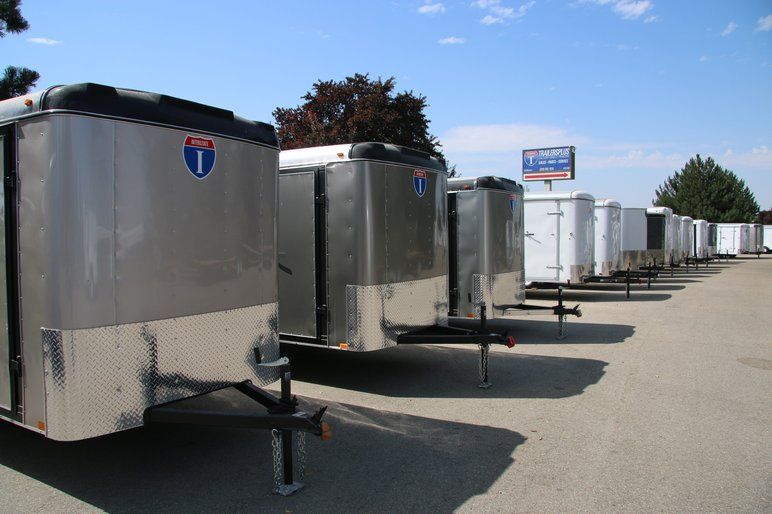
Standing between the two settles this faster than any spec sheet, because the loading difference is obvious in person and abstract on paper.
TrailersPlus is the nation's largest independent trailer dealer, with over 90 locations nationwide and more than 11,600 trailers in stock. It is the only retail seller of Interstate, America's number one brand in cargo trailers, and carries Carry-On across the open utility range. Roughly 95 percent of trailer weight is sourced in the USA, and customers rate the company 4.8 across more than 10,000 reviews. Visit a trailer dealership near you to compare them loaded, or check the marked-down trailer inventory if budget is shaping the decision.
Frequently Asked Questions
Is a cargo trailer or a utility trailer better for moving house?
For a household move an enclosed cargo trailer is generally better, since furniture and boxes need weather protection and the contents stay locked during overnight stops. An open trailer can work for a short local move in dry conditions with everything well secured.
Can you convert a utility trailer into an enclosed trailer?
Aftermarket cages, racks and tarp systems exist, but they generally do not match the weather sealing or security of a purpose-built enclosed trailer, and adding structure affects both weight balance and remaining payload. In most cases buying the format you need costs less than converting.
Which trailer type holds its value better?
Enclosed cargo trailers typically command higher resale figures than comparable open utility trailers, largely because they cost more new and appeal to a broader set of buyers. Condition, tier and how well the roof and floor were maintained usually matter more than the format alone.
Do I need brakes on either type?
Brake rules are generally tied to the trailer's gross weight rating rather than to whether it is open or enclosed, and the thresholds vary by state. Many tandem-axle models come with braking axles as standard. Check the rules that apply where you drive.
Is an enclosed trailer harder to tow?
It is generally heavier and catches more crosswind because of the tall flat sides, so it asks a little more of both driver and vehicle. Most people adapt within a trip or two, though it is worth allowing extra stopping distance and being cautious when passing trucks.