- Utility Trailers
- Equipment Trailers
- Tilt Trailers
- Trailer Knowledge
Key Takeaways: Quick Decision Guide
- A 5x10 is the homeowner sweet spot. Big enough for mulch, furniture and landfill runs, light enough for a crossover.
- Go 6-wide for a riding mower or an ATV. The extra deck width is what lets a wide mower deck sit square.
- Tandem axle is for aggregate and highway miles, not for a trailer that works six weekends a year.
- High-side rails add volume and cost payload, which suits leaves and brush rather than gravel.
- Stake pockets are the cheap upgrade, since 2x4s turn a low deck into a tall one for a single job.
For most homeowners, a 5x10 single-axle open utility trailer is the right buy. It handles garden mulch, topsoil, furniture, landfill runs and a riding mower, weighs roughly 800 lbs empty so a crossover or light truck can tow it, and stores in a standard garage bay. Step to a 6-wide deck if a zero-turn or an ATV is part of the picture, and drop to a 5x8 only if storage space is genuinely tight.
An open deck is the practical choice for domestic hauling because it loads from any angle and costs less than anything enclosed. Carry-On is the primary open utility line and covers the widest span of sizes and rail packages. What follows is the sizing detail, the features worth paying for, and what your vehicle can actually pull. If you are still deciding between formats, the types of utility trailers guide covers the wider range.
Why an Open Utility Trailer Suits Homeowners
An open deck is a different tool from a commercial hauler or an enclosed box. Compact single-axle units weigh under roughly 1,000 lbs empty, which puts them within reach of a wide range of passenger vehicles rather than only trucks.
The open layout is the other half of it. Bulk mulch, soil, gravel, lawn equipment, furniture, moving boxes and branch debris all load from the back, either side, or straight down from above, and tie-downs are reachable from any angle. Nothing has to be threaded through a door.
Storage settles it for a lot of buyers. A compact deck parks in a standard garage bay, under a carport or along a side yard pad, and one person can roll a single-axle trailer by hand on level ground.
Utility Trailer Sizes for Weekend Hauling
Across the Carry-On single-axle range, all rated at approximately 2,990 lbs, the figures run like this:
- 5x8: deck of roughly 8 feet by about 5 feet, payload of approximately 2,215 lbs. The smallest footprint, for light garden gear, trash runs and tight driveway storage.
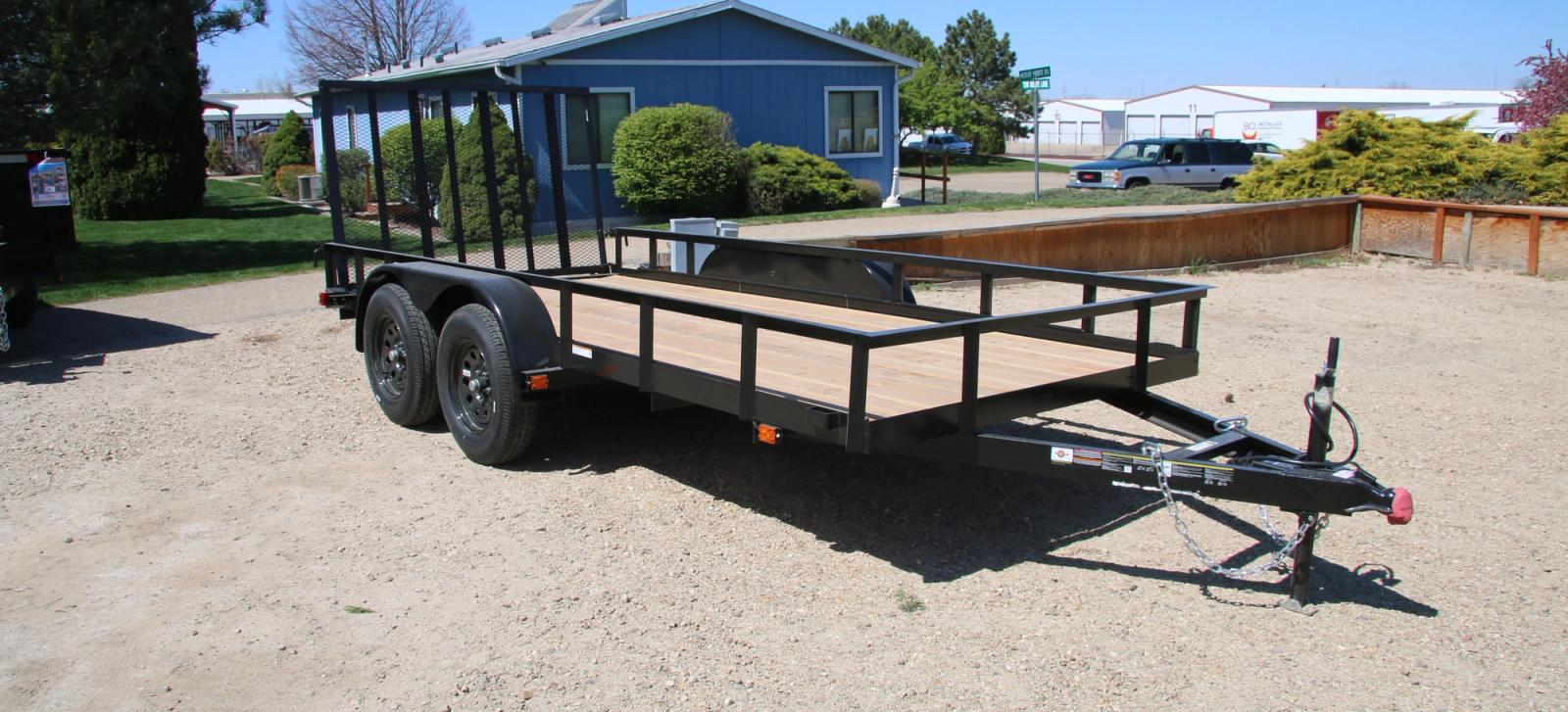
- 5x10: deck of roughly 10 feet by about 5 feet, payload of around 2,190 lbs, on an empty weight near 800 lbs. Rails of approximately 14 inches, a single leaf-spring axle, LED clearance lights and a rear fold-down ramp gate.
- 6x10 and 6x12: deck width of approximately 6 feet 4 inches, payload from around 2,140 lbs down to roughly 2,115 lbs. The extra width is what riding mowers, zero-turns, ATVs and full plywood sheets need.
- 6x14: deck of roughly 14 feet, payload near 2,090 lbs. Longer lumber, branch clearing or two appliances, still on one axle.
- Tandem axle, 6x12 to 6x16: two braked axles, rated near 7,000 lbs with payload from around 5,650 lbs down to roughly 5,350 lbs.
Please note: Listed dimensions and specifications are approximate and subject to change. Please verify exact dimensions with your local store before purchase.
Two things in that list are worth pausing on. Payload falls as the deck gets longer, because the longer trailer weighs more and that comes out of the same rating. And the step from one axle to two roughly triples capacity without changing the footprint, which is the move to make if your problem is weight rather than space.
Carry-On: The Line Most Homeowners End Up On
Carry-On builds the open utility range that covers nearly all homeowner hauling, using high-strength steel framing with angle-iron rails, protective undercoating and a wood deck. The practical options are traditional open-rail, high-side and solid-side models, all generally available off the lot rather than on order.
Rail height is the option most buyers overlook and the one that changes what you can carry. Standard decks run rails of roughly 14 inches, a mid-height package sits near 21 inches, and high-side runs approximately 24 inches. Taller rails cost payload, about 125 lbs on a 6x12, because the extra steel comes out of the same budget. Homeowners hauling leaves, clippings and brush generally want the height. Homeowners hauling gravel and pavers generally do not, since those loads hit the weight limit long before they fill the deck.
Please note: Listed dimensions and specifications are approximate and subject to change. Please verify exact dimensions with your local store before purchase.
Karavan also appears on the lot with modular steel utility trailers, though the range is narrowing. If your hauling involves heavy machinery such as a skid steer or a compact tractor, neither line is the answer; that work belongs on an equipment or tilt trailer.
Features Worth Paying For
A rear fold-down ramp gate is the feature that earns its cost first. It loads zero-turns, push mowers and wheelbarrows without auxiliary boards, and an expanded metal gate gives a shallower incline than the alternative.
Welded stake pockets are the cheapest useful upgrade on any open deck. Drop standard 2x4 posts in, attach plywood or slats, and you have temporary tall walls for a leaf or brush haul without paying for high sides year round.
Side rail style matters for what stays on board. Open angle-iron rails let you strap from the side, while expanded mesh or solid steel sides contain loose soil, gravel and mulch. Straps, ratchets, racks and E-track anchor points are all available through trailer parts and accessories, and low deck height is worth checking too, since it sets the ramp angle you will be pushing a mower up.
On axle choice, the honest position is that most homeowners do not need two. Single-axle trailers are lighter, cheaper, easier to move by hand and carry roughly a ton. Anyone hauling heavy aggregate regularly, or towing at highway speed over long distances, is the buyer a tandem is for, and the comparison between single axle and tandem axle goes into why stability rather than capacity is usually the reason.
What Can Tow a Utility Trailer
A light single-axle utility trailer, weighing roughly 800 lbs empty against an approximately 2,990 lb rating, can usually be towed by many mid-size SUVs, crossovers, pickups and minivans fitted with a standard 2-inch hitch ball and a 4-way flat connector.
Please note: Listed dimensions and specifications are approximate and subject to change. Please verify exact dimensions with your local store before purchase.
Verify before you buy rather than after. Your total loaded trailer weight is the trailer's empty weight plus everything on it, and that figure wants to sit comfortably inside your vehicle's rated towing capacity, which is in the owner's manual and often on the driver's door jamb. Storage space is the other constraint people forget, so measure the bay before you commit to a 14-foot deck.
Shop Utility Trailers at TrailersPlus
Standing next to two deck widths settles this faster than any spec sheet, because the difference between a 5-wide and a 6-wide is obvious in person and abstract on paper.
TrailersPlus is the nation's largest independent trailer dealer, with over 90 locations nationwide and more than 11,600 trailers in stock. It is the only retail seller of Interstate, America's number one brand in cargo trailers, and carries Carry-On across the open utility range. Roughly 95 percent of trailer weight is sourced in the USA, and customers rate the company 4.8 across more than 10,000 reviews. Any trailer can be reserved online for a 7-day hold with a fully refundable deposit, and every trailer includes two complimentary 40-point inspections at the 12-month and 24-month marks. Traditional financing and rent-to-own are both available through the trailer financing options page, and you can browse the current trailer inventory before you visit.
Frequently Asked Questions
What vehicle can tow a utility trailer?
A light single-axle utility trailer, roughly 800 lbs empty with an approximately 2,990 lb rating, can usually be towed by many mid-size SUVs, crossovers, minivans and pickups with a 2-inch hitch ball and a 4-way flat plug. Check your vehicle's rated towing capacity and keep the total loaded weight inside it.
What size utility trailer is best for a homeowner?
A 5x10 single-axle deck suits most homeowners. It carries garden mulch, topsoil, a riding mower, household furniture and landfill runs while staying light and easy to store. Drop to a 5x8 if storage is tight, or move to a 6-wide deck for a zero-turn or an ATV.
Should I choose a single-axle or tandem-axle utility trailer?
For typical weekend use a single axle is usually the better buy. It is lighter, cheaper, easier to move by hand and carries roughly a ton. A tandem makes sense if you haul heavy aggregate regularly or tow at highway speed over distance, where the second axle adds capacity and stability.
Can I load a riding mower onto a utility trailer with a fold-down gate?
In most cases yes. An expanded metal fold-down ramp gate gives a shallow incline that lets riding mowers, push mowers and wheelbarrows roll onto the deck without separate ramps. Check your mower's cutting deck width against the trailer's deck width first.
How do I build taller sides for hauling leaves or brush?
Most steel utility trailers have welded stake pockets along the side rails. Drop standard 2x4 posts into them and attach plywood or slats to create temporary tall walls. That costs far less than a permanent high-side package and comes off when you do not need it.