- How To
- Parts
- Trailer Knowledge
If you’ve just bought your first trailer, figuring out which hitch ball you need might not seem obvious. But it’s one of the most important pieces of the entire towing setup. Ball hitches come in different sizes and weight ratings, and using the wrong one can lead to trailer sway, poor handling, or even a full disconnect.
This guide walks you through how to match your trailer’s coupler to the correct hitch ball—by size, weight capacity, and shank diameter—so you can tow safely and legally from day one.
What Is a Trailer Ball Mount?
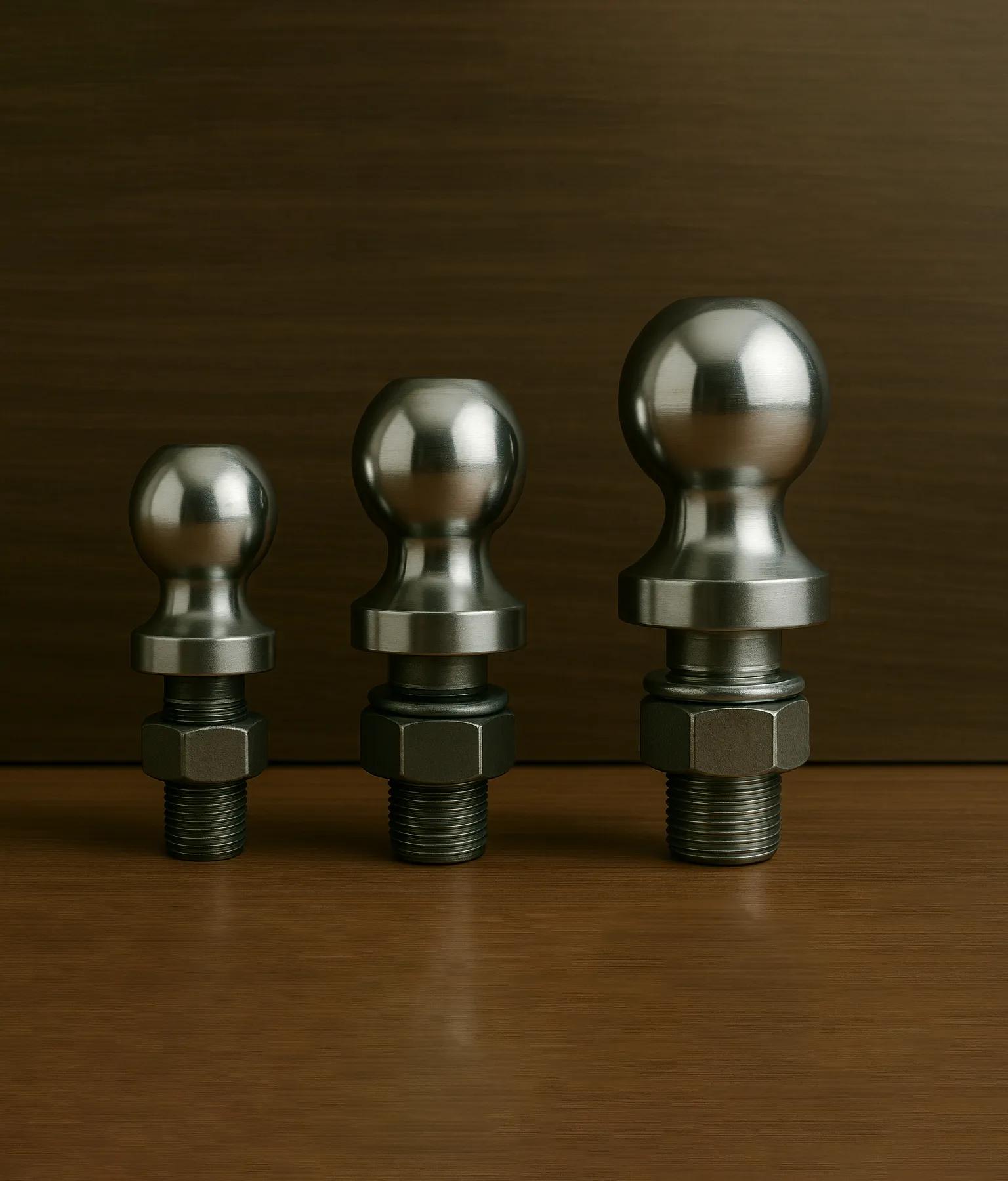
A trailer ball mount—also called a tow ball—is the metal ball that connects your tow vehicle to the trailer’s coupler. It mounts to your ball mount or hitch receiver and allows the trailer to pivot smoothly behind the vehicle during turns.
The hitch ball carries the full tongue weight of the trailer and must align precisely with the coupler in both size and weight rating. Each trailer coupler is designed for one specific ball diameter—usually stamped or molded into the metal on top of the coupler. Using the wrong ball size, even if it seems close, will lead to a loose fit or binding, either of which can cause damage or loss of control while towing.
What Are the Different Ball Mount Sizes?
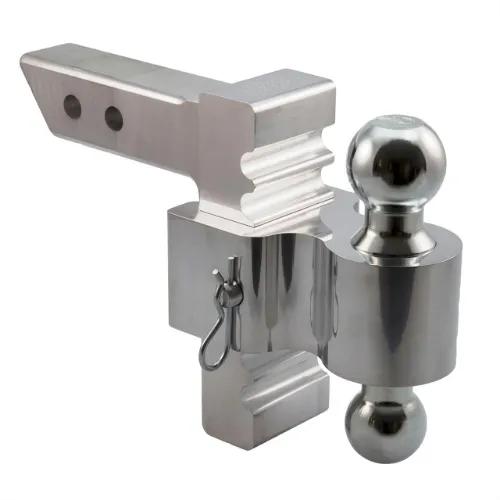
Bumper-pull trailers use one of three standard hitch ball sizes. Each is matched to a specific range of trailer weights and coupler types. Here’s what you need to know:
- 1-7/8" Hitch Ball – Designed for light-duty towing, this ball size is common on small utility trailers, and compact cargo haulers under 2,000 pounds. It's a good match for passenger vehicles, compact SUVs, or anyone towing on an occasional basis for short distances. Because of its lower weight rating, it's not suitable for commercial use or any load where stability under speed or weight shift is a concern.
- 2" Hitch Ball – A much more common size, a 2" ball supports trailers with gross weights between 3,500 and 7,500 pounds. You’ll find these on enclosed cargo trailers, small car haulers, landscape trailers, and recreational units like ATV or UTV haulers. They’re popular with homeowners, small business owners, and contractors who tow frequently but don’t need a heavy-duty setup.
- 2-5/16" Hitch Ball – This larger ball is required for heavy-duty trailers such as dump trailers, equipment haulers, and full-size tandem axle car haulers. These setups often exceed 10,000 pounds, so the increased size is critical for handling higher tongue weights safely. A 2-5/16" hitch ball offers better surface contact and load distribution, making it essential for stability and safety.
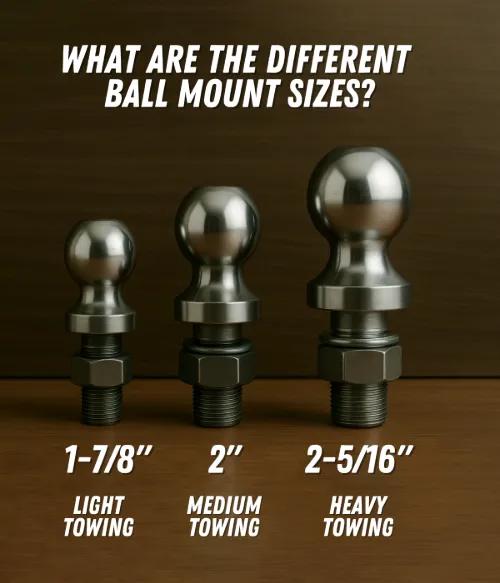
Your trailer’s coupler is built for one specific ball diameter. Even the smallest difference is unsafe. If the ball is too small, the coupler won’t grip it properly. If it’s too large, the latch won’t close. Either case can lead to detachment while towing.
Hitch Ball Ratings: Why Size Alone Doesn’t Guarantee Safety
Hitch balls are load-rated components, not interchangeable hardware. Each ball is assigned a maximum Gross Trailer Weight (GTW)—the total loaded weight it is certified to tow safely—and this rating is stamped directly on the top of the ball. The rating reflects the combined strength of the ball’s material, shank diameter, threading, and how it was manufactured (forged vs. welded, for example).
A common mistake made is to assume that ball size alone determines capacity, but that is incorrect. While the diameter of the ball must match the trailer coupler, the GTW rating must meet or exceed the trailer’s actual loaded weight, including cargo, fuel, and equipment. Using an undersized or underrated ball—even if the fit appears correct—creates a major failure point in the towing system.
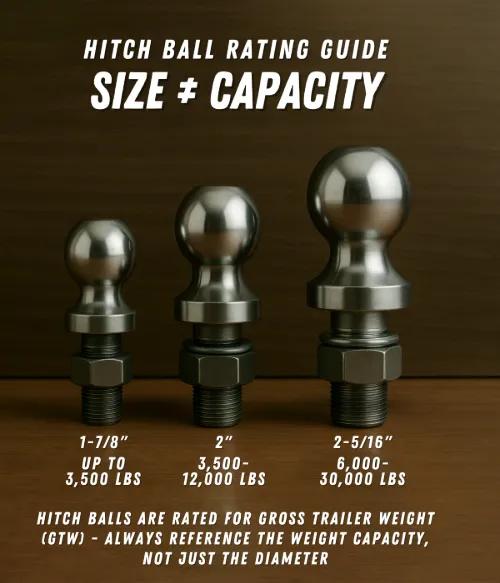
Examples:
- 2" Hitch Ball – This ball size is widely used, but the rating can vary from 3,500 to 12,000 pounds depending on the shank diameter, steel quality, and how it’s built. Just because it fits the coupler doesn't mean it can handle the full load.
For example, a 3,500 lb–rated 2" ball may be fine for a small utility trailer carrying lawn tools, but it should never be used to tow a 5,000 lb enclosed cargo trailer. That job requires a stronger version rated to at least 7,500 lbs—with a 1" shank.
- 2-5/16" Hitch Ball – Common on heavy-duty trailers, this size ranges from 6,000 to 30,000 lbs in rated capacity, depending on shank size and build quality. It’s often used in tandem axle setups or gooseneck applications that demand more strength at the connection point.
You can safely use a 2-5/16" ball rated for 14,000 lbs to pull a loaded dump trailer or equipment hauler. But that same trailer can’t be paired with a 10,000 lb–rated ball, even if it physically fits the coupler—it would exceed the rating and risk failure under load.
In short, match the GTW rating first, not just the ball size. Always verify the stamped weight capacity and pair it with a properly rated mount, shank, and towing vehicle. Towing beyond a hitch ball’s certified limit increases the risk of coupling failure, loss of control, and severe mechanical damage.
What Is a Hitch Ball Shank—and Why Does Size Matter?
The shank is the threaded stem of the hitch ball that inserts through the ball mount or drawbar. It is the primary mechanical connection between the hitch ball and the towing vehicle. Any mismatch here directly increases the risk of trailer separation or hitch system failure.
Standard Shank Sizes and Towing Ratings:
- 3/4" Shank – Engineered for light-duty towing applications under 3,500 pounds. Found on small utility trailers, lawn equipment haulers, or trailers towed by compact SUVs and cars.
- 1" Shank – The most common size in Class III setups, suitable for loads from 3,500–7,500 pounds. Common on single-axle enclosed trailers, recreational haulers, and general-purpose work trailers.
- 1-1/4" or 1-3/8" Shank – Required for high-capacity trailers over 10,000 pounds. These larger shanks are used with equipment trailers, tandem axle dump trailers, and other commercial-duty loads where high tongue weight and dynamic stress demand a reinforced hitch structure.
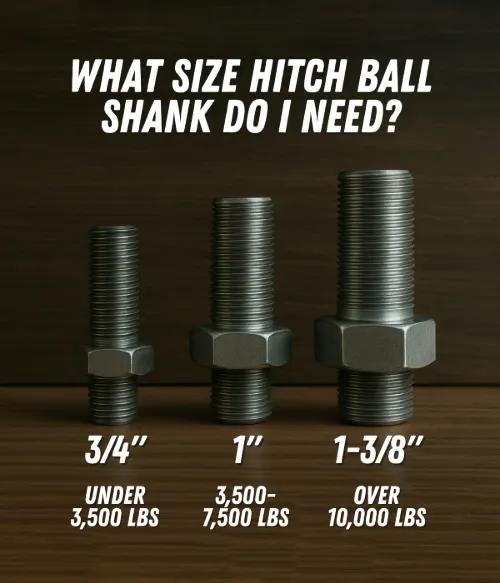
If the shank is smaller than the mount hole, even a torqued connection will allow lateral movement, which can loosen under vibration and lead to structural failure. If it’s too large, the ball simply won’t install correctly—forcing it into place compromises the mounting integrity and renders the hitch unsafe.
Always verify both the shank diameter and the mount hole size before installation.
Choose the Right Hitch Ball
Responsible towing starts with the right hitch ball. It’s responsible for carrying the full tongue weight of your trailer and maintaining a secure link between the trailer and your tow vehicle. The shank diameter and GTW rating must also align with your trailer’s total loaded weight and towing conditions.
Using a ball that’s too small, incorrectly rated, or poorly matched to your mount is not a minor oversight—it’s a structural failure point that puts your cargo, vehicle, and safety at risk. Always check the specifications stamped on the hitch ball and verify compatibility with your trailer and towing equipment.
If you're unsure, come visit your local TrailersPlus. We can help you get set up with the right hitch ball to safely haul your trailer.